


Panevėžys receives attention from „The Economist“
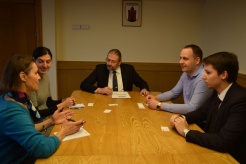
The journalist from one of the oldest and largest world weekly news magazine “The Economist“ Slavea Chankova visited Panevėžys.“The Economist“ is working on a large investigation about migration flows (especially from Central and Eastern Europe (CEE) and will discuss how certain regions, cities, local businesses are affected by that, what the challenges are and how should they be tackled.
The Mayor of Panevėžys City Rytis Račkauskas, the Project Manager of Panevėžys Free Economic Zone (FEZ) Daumantas Simėnas and the Chief Operating Officer of the Company “Devold“ Bjarne O. R. Moller were present at the meeting with the journalist.
Overall decrease of youth in regions, attractiveness of larger cities and a hopeful slowly growing tendency of young people coming back to their native town from large cities have been discussed. The biggest challenge is the academic sector in Panevėžys: it is hard to motivate students after high school to choose local higher education schools and vocational training centres. The supply of well-qualified labour force is more competitive than it used to be. The city faces the challenge to increase the number of such professionals and works closer with both business and educational institutions.
“We had a fruitful discussion with Ms Slavea Chankova about global migration challenges connected with Lithuania and our city. The present investors are satisfied with the city and so far they have managed to find qualified workers. Nevertheless, due to expansion of several companies there is a tendency that the competition for qualified labour force is slowly growing. Thus, we have to encourage young people to stay, to come back and live in Panevėžys. The main tool for that is well targeted and clear communication with the message that the city has quality and well-paid jobs available and it has perfect conditions for living and raising a family. Increasing the attractiveness of the city is one of our solutions of encouraging people who left Panevėžys to maintain closer ties with our city and consider coming back to live here. Therefore, we hope to move forward largely in implementing investment projects under the frames of URBAN and other programmes“, - said R. Račkauskas.
On the other hand Panevėžys FEZ is active in attracting foreign direct investments and making them interested in the city. Together with the municipality Panevėžys FEZ helps with a lot of “soft“ measures – it tries to increase the prestige of vocational education, helps local higher educational schools to attract students, contributes in establishing new, advanced training facilities, assists the companies and mediates between Labour Exchange and vocational training centres in preparing required specialists for companies. Also the challenges of youth involvement, vocational guidance and general attractiveness of the city are also being worked on.
The Chief Operating Officer of the Company “Devold“ Bjarne O. R. Moller stressed that Panevėžys is a very comfortable place to live in. It is compact, not expensive and suitable for family life, it is easy to find a place in a kindergarten. Transport connection is perfect – good access with larger cities of Vilnius, Riga and 3 international airports. Besides, Lithuanian weather is fantastic – spring, summer and autumn are all beautiful and warm. It cannot be compared with Norwegian climate. Thus, these competitive advantages of Panevėžys in comparison with other counties and regions have to be communicated much more actively.
In December, a big investigative article of the migration situation in the CEE region will appear in the weekly “The Economist“ and will have a case-study of Panevėžys city in it.
The Department of Communication

Comments (0)